
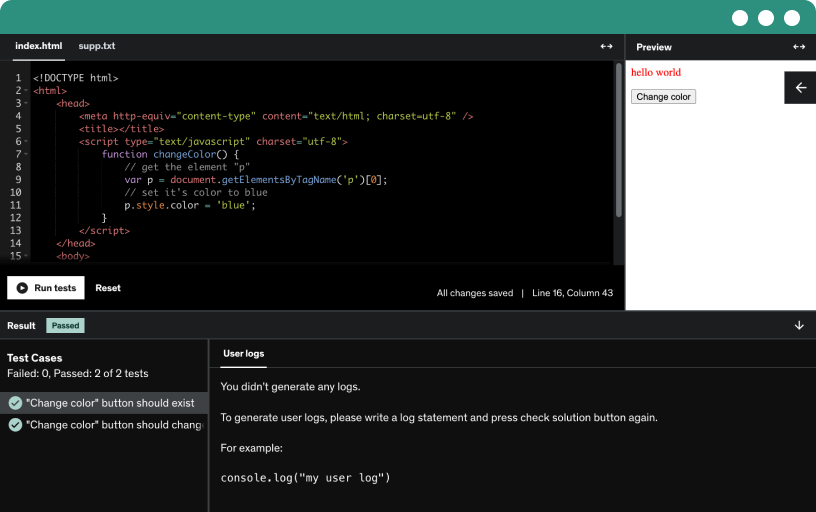
This course includes our updated coding exercises so you can practice your skills as you learn.
See a demo
Discover how Python software libraries simplify coding for learners of all levels in this course trailer. Explore the role of libraries in practical Python programming for everyone.
Explore python fundamentals—from variables and data structures to loops, input/output, and file handling—then build a blackjack game using classes, inheritance, and error handling.
Explore variables in Python: store and update data with assignment, print values, and distinguish global from local scope. Learn integers, floats, strings, constants, and shorthand operations.
Explore how functions work in Python: define with def, use input parameters, indent for the function body, return outputs, and call reusable blocks of code.
Explore how if statements control program flow with conditions, booleans, comparisons, and indentation in Python, using real-world examples of elif and else.
Learn how lists store multiple data in a single variable using square brackets and commas, access elements with zero-based indexing, slice, and append items, demonstrating heterogeneous types and nested lists.
Learn how to use for loops in Python to iterate over strings and lists, build sequences with range, and apply append and conditions to extract letters or numbers.
Learn how while loops use a condition and a counter to repeat actions, print results, accumulate sums, and traverse lists from index 0 to the list length.
Explore how break and continue statements control loop flow in Python, using a participant list to show stopping a loop and skipping iterations for efficient control.
Learn to create triangle shapes with for loops in Python by using a length variable and a printable character, printing progressively to visualize loop flow and output.
Learn to build a tic tac toe field in Python using nested loops, for loops, and simple control flow to print rows, separators, and cell borders.
Explains sets and dictionaries in Python, contrasting them with lists. Showcases removing duplicates to keep unique elements with sets and counting occurrences with dictionaries using key-value pairs.
Explore how to manage a shoe store inventory using Python dictionaries, with keys as sizes to track stock and a loop to process purchases and out-of-stock checks.
Master input and output in python by prompting users, printing results, and converting input to integers, floats, or strings. Build interactive programs using loops, lists, and formatted prints.
Learn how to read from and write to files in Python, using open, read, write, append, and plus modes, with proper closing and the with statement.
Learn to build a Python tic tac toe game by creating a draw field function to render board, prompt two users for moves, and store them in a 3x3 list.
Learn to build a smooth tic tac toe game in Python by drawing the board, handling user input, preventing overwriting moves, and defining when a player wins and draws.
Develop a Python workflow that collects participant data via user input, stores it in a nested list, and writes it to a file for later reading and basic analysis.
Read data line by line from a file, parse it into a list, and transfer ages into a dictionary to show distribution.
Discover simple statistics with file-based data by using dictionaries to track ages, count occurrences, and identify the oldest, youngest, and most frequent ages.
Learn how to define a class, initialize it, and manage attributes and methods with a team example. Instantiate teams, access and update attributes, and use default values.
Explore Python class inheritance by building a team class and a player subclass, showing how to initialize parent attributes, add new properties and methods, and customize string output.
Define a general pet class with name, age, hunger, and playful, initialize them, and use getters and setters. Instantiate pets, modify properties, and preview inheritance for dogs and cats.
Demonstrate inheritance by creating a dog class that inherits from pet, adding breed and a favorite toy, then instantiate a husky named Snow to test wants to play.
Explore inheritance in Python by building a cat class that inherits from a pet base class, initializes attributes, overrides __str__, and defines a sit method that prints its status.
Create a human class that stores pet objects in an array, access them, and illustrate inheritance with dog and cat classes, showing how objects inside objects work.
Explore external libraries in Python by importing the random library, accessing its functions, and generating random integers, floats, and uniforms, with optional aliases to streamline usage.
Explore different ways to import libraries in python, use aliases and from-imports, and apply the random library to select from lists and shuffle elements.
Learn to use the time library to measure the speed of code blocks with time.clock and to pause execution with sleep, timing loops and delays.
Explore the Python math library, import math, and use functions like sqrt, exp, factorial, sin, floor, and ceil to perform common operations, with attention to radians and rounding limits.
Build a random guessing game using the random library to generate a random integer and have the user guess it, with feedback for too low or too high.
Learn how to let the computer guess a random float between 0 and 1 by using a binary search approach, updating lower and upper bounds, and measuring performance with clock.
Develop a blackjack game by building a deck with a reusable function and shuffling it with Python's random library to produce a random card order.
Create a Python player class for the game, including an initializer that sets hand, score, and money, and a score calculator with ace handling and face-card mapping.
Expand the player class to handle new cards in blackjack, add a hit method and a new game reset, and begin implementing a simple betting system to track money.
Expand the player class with a bet property and bet method, move money to the bet, and apply two times payout, with 2.5 times for blackjack, then reset the bet.
Learn how to draw cards from a shuffled deck using pop, assign hands to a player and the house, and handle user input to hit or stand while tracking scores.
Implement blackjack gameplay by adding a has blackjack check, betting, automated house draws, and a looping round with deck reshuffling and outcome scoring.
Graphing & Programming for Everyone: Math & Computer Science
Don't miss out on this epic course of web programming and using the latest technology for prediction and data analysis. Enroll now to learn Python, Matplotlib, and NumPy - three massive topics in one straightforward course.
This course was funded by a wildly successful Kickstarter.
Do you want to learn how to visualize data? Enroll in this course to learn how to do so directly in code. This course is suitable for coding beginners because we begin with a complete introduction to coding. Then we delve deep into using Matplotlib, a Python 2D plotting library.
Learn how to use Python, a popular coding language used for websites like YouTube and Instagram.
You learn the basics of programming, including topics like variables, functions, and if statements. You learn about data structures such as lists, dictionaries, and sets. We cover how to use for and while loops, how to handle user input and output, file input and output.
We apply our knowledge to build a fully functional tic-tac-toe game. You learn classes, methods, attributes, instancing, and class inheritance. We make an additional Blackjack game! You learn how to solve errors that can occur when you work as a programmer.
Take your Python knowledge and apply it to Matplotlib.
We go over many cool features of Matplotlib that we can use for data visualization. We show you how to make line plots, scatter plots, candlestick plots. You learn how to customize the visuals of your graph and to add text and annotate graphs. And much more!
Go through every step you need to create and shape NumPy and 2D arrays.
Learn how to resize, format, and sort arrays. Then we cover how to perform calculations within NumPy arrays. You learn about math functions, statistics, and polynomials with NumPy.
Choose this course today
We prioritize learning by doing. We blend theory with practical projects to ensure you get a hands-on experience by building projects alongside your instructor. Our experienced instructors know how to explain topics clearly at a logical pace. Check out our huge catalog of courses for more content.
“The Instructor goes very in-depth about everything. This is very helpful to remember all these different things!” – KingSloth_GameStudio on The Ultimate iOS 11 Course
“I really like the approach the presenter takes – not just the technical details, but also the very human, personal development information and recommendations he provides.” – Michael on The Ultimate iOS 11 Course
“The instructor is very good at teaching. He teaches at a great pace and covers anything a beginner would need to understand (every little detail). I am already learning a lot and I just started yesterday. – Mike on Build 30 Mini Virtual Reality Games in Unity3D from Scratch
Enroll now to join the Mammoth community!